The most dangerous sentence in bridge erection may be “We’ve done something similar before.” On multi-span structures and repeated lifts, repetition builds confidence, and confidence is useful: it is how a programme reaches a steady cycle. The risk is in what the repetition carries with it.
This article is an editorial reading of that risk. It draws on documented projects on this site; the pattern it describes is an observation, not a statistical finding.
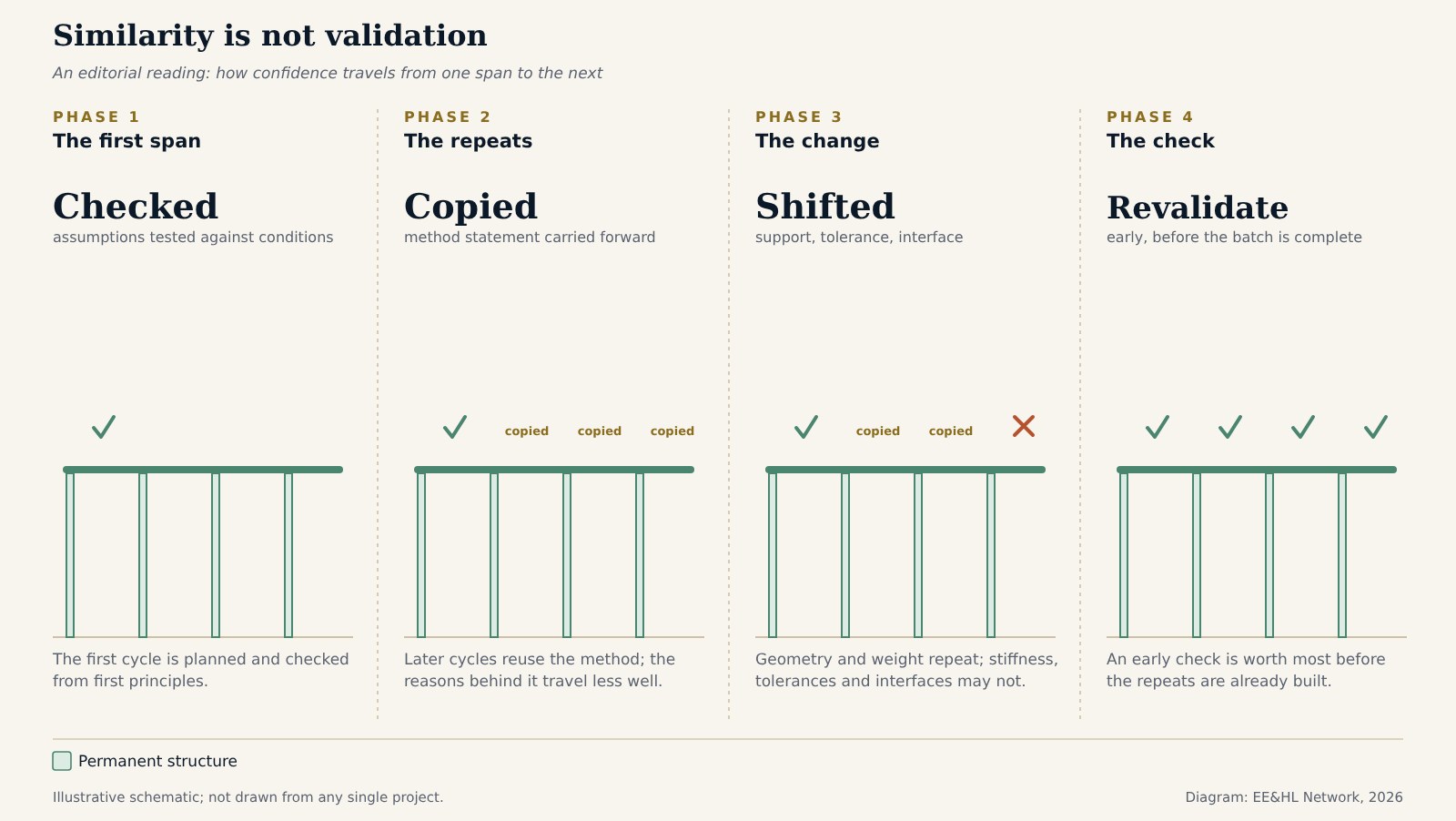
Diagram: EE&HL Network, 2026.
Tap or click the diagram to open it full size.
What repeats, and what does not
How similarity is transmitted
Confidence can travel without a calculation behind it: as a slide deck reused without rechecking its assumptions, a method statement copied forward, a briefing that passes on the “what” but not the “why”, and schedule pressure that shortens the time left for checking. Each of these is reasonable on its own. Together they can let yesterday’s logic be applied to today’s boundary conditions.
What documented projects show
On the Gilberto Borja Navarrete Viaduct, the design specified sonic testing of the pier 4 piles after the first few were cast, so that problems in the procedure would be caught early. According to the design team’s paper, the tests ran only after all 64 piles were complete, and only 14 of the 64 showed no anomalies. An early check is a test of whether the repeated procedure works. Its value depends on how many repeats exist by the time the answer arrives.
At 461 Dean Street, small dimensional variances in factory-built modules were reported to have compounded into alignment problems as the stack climbed to 32 storeys. The modules repeated; the consequence of their tolerances did not.
The Sheikh Zayed Bridge shows the opposite discipline. Its arch structure was divided into 22 segments with no shared geometry, and, as the case study records, each needed its own erection study: its own lifting and rotation sequence, temporary supports and welding procedure.
Experience is valuable. Experience without revalidation becomes assumption, and assumption under time pressure becomes exposure.
A practical reading
The useful question on a repetitive job is not whether this cycle looks like the last one, but what has changed around it: support, tolerance, sequence and interface. A reasonable reading is that early checks deserve protecting in the programme, because they are worth most before the batch is complete. That is an editorial observation, not a recommendation for any specific project.
For related readings, see When the Erection Method Becomes the Project and What is Erection Sequence Risk?. The newsletter’s Issue 19 looks at the San Marcos test sequence in commercial terms.
Related case studies: Gilberto Borja Navarrete Viaduct · 461 Dean Street · Sheikh Zayed Bridge
Sources: EE&HL Network — Gilberto Borja Navarrete Viaduct, with its primary source, Arribas Mazarracín et al., Hormigón y Acero 66(275), 2015; EE&HL Network — 461 Dean Street, with its sources; Baird-Remba, R. — “Modular Construction Technology Comes Far and Fast During the Pandemic”, Commercial Observer, 27 September 2022. Further reading, not consulted for this page: an interview with Andrew Staniforth, who worked on 461 Dean Street; EE&HL Network — Sheikh Zayed Bridge, with its sources
Frequently Asked Questions
Because repeated cycles usually share geometry and weight but not always support conditions, tolerances or interfaces. When a method is carried forward without rechecking what has changed around it, an assumption that held for the first cycle can be applied where it no longer holds.
It can pass through documents and habits rather than calculations: reused slide decks, method statements copied forward, briefings that skip the reasons behind a step, and schedule pressure that compresses checking.
An early check tests whether a repeated procedure works. On the Gilberto Borja Navarrete Viaduct, pile testing specified after the first few piles ran only after all 64 were built, when its result could no longer protect the rest of the batch.
No. It is an editorial reading drawn from documented projects on this site, not a statistical analysis of erection incidents.