The Gilberto Borja Navarrete Viaduct, known during construction as the San Marcos Viaduct, carries the Mexico City–Tuxpan motorway across the valley of the San Marcos river in the Eastern Sierra Madre, in the state of Puebla. Its 850 m deck runs over six piers of 33, 76, 166, 208, 121 and 54 m. According to the design team’s paper in Hormigón y Acero, pier 4 was, at the time of construction, the tallest ever built in a balanced cantilever bridge.
The viaduct sits on a 36 km section, from Nuevo Necaxa to Ávila Camacho, that needed six tunnels and 12 viaducts. Design and construction were awarded to CONNET, a joint venture of FCC Construcción and ICA, and FCC’s technical services designed the structure. Work began in March 2009 with the foundations of pier 4. The main structure was completed in November 2012, and the section opened to traffic in September 2014.
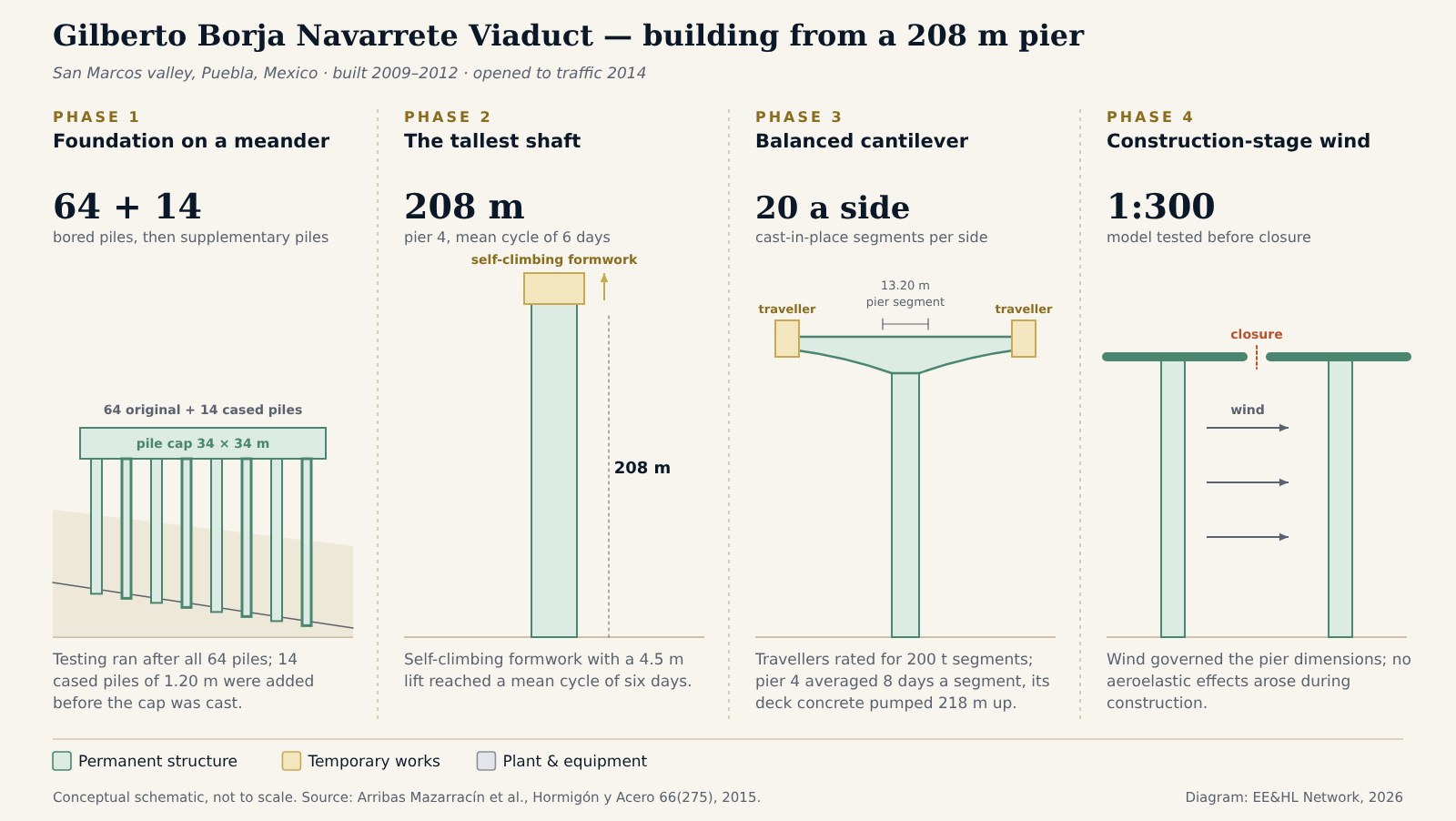
Source: Arribas Mazarracín et al., Hormigón y Acero 66(275), 2015. Diagram: EE&HL Network, 2026.
Tap or click the diagram to open it full size.
At 208 m the governing cases moved: the foundation took more than a year to resolve before the pier could rise, and the wind had to be checked on a structure that was not yet a bridge.
The decks were finished in the order the cantilevers allowed: pier 2 in February 2012, piers 5 and 3 in June and July, and pier 4 last, in September 2012, with the closure joints locked between July and November. The design team’s paper notes that the pier 4 deck conditioned the construction time. Read alongside the foundation dates, that suggests the year spent on pier 4’s piles carried through to the end of the programme. That is an editorial reading; the paper does not quantify the delay or say what it cost.
For the commercial reading of the pier 4 test sequence, see Issue 19 of the EE&HL Newsletter. For the method itself, see What Is Balanced Cantilever Construction?; for another record tall-pier cantilever, see the Kochertal Bridge.
Related case studies: Millau Viaduct · Kochertal Bridge · Chenab Bridge
Core concepts: What is erection engineering? · What is heavy lift engineering?

Photo: HighestBridges, via Wikimedia Commons, CC BY-SA 3.0.
Sources: Hormigón y Acero 66(275), 2015 — Arribas Mazarracín, D., González Esteban, J. I., Pérez Casas, J. M. and Bernal Sahún, P., “Gilberto Borja Navarrete Viaduct”, the design team’s paper (English edition; Spanish edition): geometry, pier heights, foundation, construction sequence, travellers, cycle times, wind studies and dates; FCC — 2015 Lieberman Prize announcement, naming and participants
Frequently Asked Questions
Pier 4 rises 208 m from the valley floor. According to the design team’s paper in Hormigón y Acero, it was, at the time of construction, the tallest pier ever built in a balanced cantilever bridge. The other five piers are 33, 76, 166, 121 and 54 m tall.
The inner spans were built by balanced cantilever with cast-in-place segments, using three pairs of form travellers supplied by Freyssinet México and rated for segments of up to 200 t. Each cantilever had a 13.20 m pier segment and 20 segments per side. The two end spans, each with a 6.5 m cantilever into the adjacent span, were built on falsework.
Sonic testing of the 64 bored piles, specified after the first few piles, ran only after all 64 were finished in July 2009. Only 14 of the 64 showed no anomalies, and 53% of the piles built were accepted after cores and recalculation. Grout injection was completed in March 2010 but could not repair enough piles; in May 2010 the foundation was strengthened with 14 supplementary cased piles of 1.20 m, completed in June 2010.
Yes. The paper states that wind governed the dimensioning of the piers. A 1:300 model tested the bridge before the closure segments were cast, and no aeroelastic effects arose during construction.
Design and construction were awarded to CONNET, a joint venture of FCC Construcción and ICA, with the structure designed by FCC’s technical services. The owner was Mexico’s Communications and Transport Secretariat (SCT).