Temporary works design and management depend on the loads, the conditions and the anticipated period of use. The load is written down and checked. The period of use is often an assumption in the background: the supports will be there for a few weeks, the propping until the slab gains strength, the tower until the stays are in. When the programme moves, the load is still checked. The period of use is not always revisited.
HSE’s guidance on temporary works names the attitude behind this. Because temporary works may be in place for only a short while, it says, there is a tendency to assume they are less important. The same guidance notes that temporary works can be sensitive to how they are used and to work going on nearby, and that failures are often linked to loadings that were underestimated.
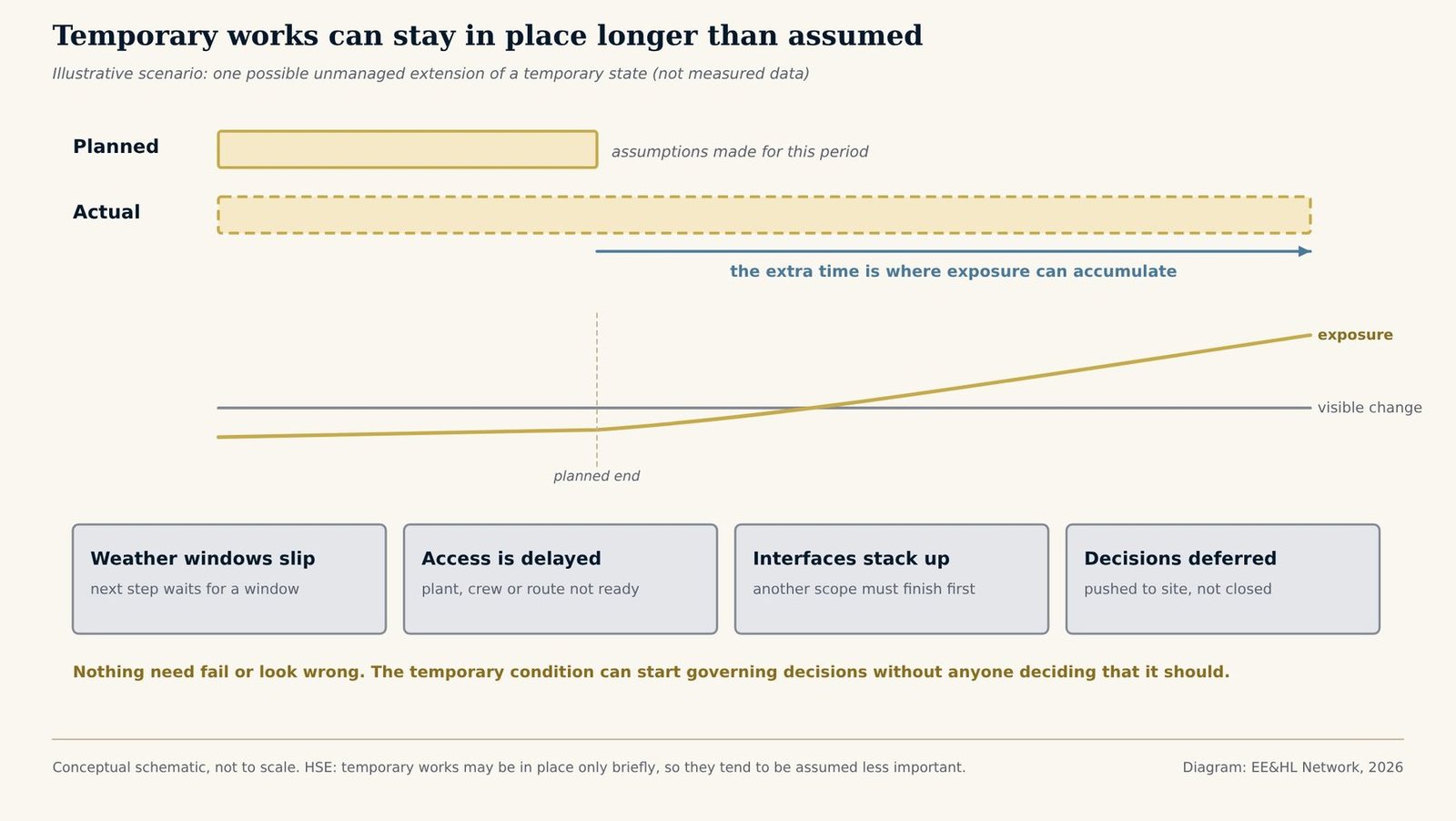
Tap or click the diagram to open it full size.
Why staying longer changes the risk
A temporary state that lasts longer than planned can meet more of everything: more weather, more nearby activity, more changes of crew, more opportunities for an adjacent trade to lean on it, remove a brace or load it in a way nobody considered. None of this needs a single dramatic event. The temporary condition can start to govern decisions without anyone deciding that it should. That is an editorial reading of the HSE points above, not a quotation.
Four ways it happens
Where documented projects show the dependency
At the Millau Viaduct, the release of the temporary towers depended on the stay-cable installation schedule; see the Millau case study. At the Krk Bridge, each half of the arch stood on tie-back cables anchored in rock until the crown was closed, so the duration of that temporary state was set by the progress of the whole arch; see the Krk Bridge case study. Neither source records a problem from duration. Both show how the life of temporary works is set by something other than the temporary works themselves.
What the UK framework already provides
HSE describes temporary works coordination as including making sure temporary works are correctly installed, used, checked and maintained, which reaches across their whole life and not only their design. BS 5975 sets out the temporary works co-ordinator role as industry good practice; HSE notes that there is no legal requirement to use that job title. A practical reading is that a change in programme can affect the assumptions in the temporary works brief, and is worth sending back to whoever designed and checks them. That is an editorial observation, not a contractual or legal recommendation.
For related reading see Temporary Works & Erection Strategy, What Is a De-Propping Sequence? and the insights Why Removing Temporary Works Can Be Riskier Than Installing Them and The Contract Boundary No One Defines.
Related case studies: Millau Viaduct · Krk Bridge · Beijing National Stadium · Grande Arche · Singapore Sports Hub
Sources: Health and Safety Executive — Temporary works FAQs (tendency to assume short-lived temporary works are less important; sensitivity to use and nearby work; underestimated loadings; coordination role; BS 5975 and the job title); BS 5975-1:2024 — Management procedures for the control of temporary works, British Standards Institution; EE&HL Network — Millau Viaduct temporary towers release sequence, with its primary sources; EE&HL Network — Krk Bridge, with its primary sources. The exposure curve in the diagram is conceptual. The four causes are typical patterns, not drawn from a documented incident. HSE guidance is paraphrased; see the source for its exact wording.
Frequently Asked Questions
Because a longer life can bring more weather, more nearby activity and more chances for the temporary works to be used or loaded in ways that were not considered, and the assumptions behind their design, inspection and maintenance may not be revisited. Often there is no visible change that would prompt a review.
HSE’s temporary works guidance says that because temporary works may be in place for only a short while, there is a tendency to assume they are less important. It also notes that temporary works can be sensitive to how they are used and to nearby work.
Typical causes include weather windows slipping, plant, crew or access not being ready, another scope having to finish first, and open design or method decisions being deferred to site.
HSE describes temporary works coordination as including making sure temporary works are correctly installed, used, checked and maintained. BS 5975 sets out the temporary works co-ordinator role as good practice, although HSE notes there is no legal requirement to use that title.