Wind is usually discussed as a limit: the lift can go ahead below a certain speed and cannot above it. That is true and incomplete. A heavy lift or marine operation does not need the wind to be below the limit at one moment. It needs it to stay acceptable for the whole operation, plus the time to stop safely if something goes wrong, and it needs the forecast to say so with enough confidence before work starts.
A window is longer than the operation
For weather-restricted marine operations that must either be completed once started or allow time to abort safely, Empire Engineering summarises the approach of DNV’s marine operations standard, DNV-ST-N001, as follows. The planned operation period covers the design duration of the operation together with a contingency and the time needed to abort, and the forecast-issue interval also enters the planning. Forecasts are uncertain, so the design limit is reduced by an alpha factor to an operational limit that the forecast must stay below. The window the operation needs is therefore longer than the operation, and the limit it must meet is lower than the design limit. The DNV standard itself was not consulted for this article; its definitions govern.
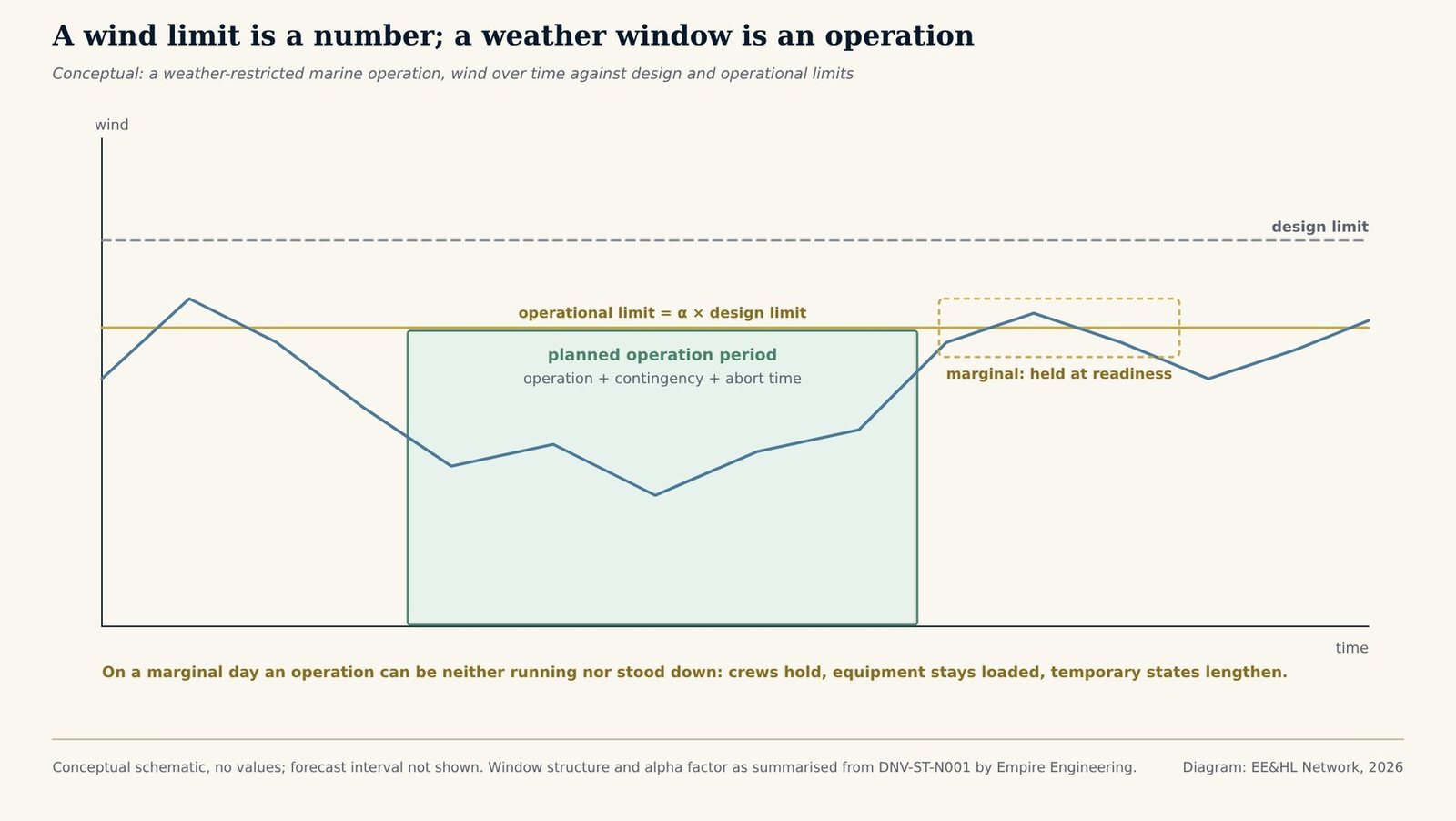
Tap or click the diagram to open it full size.
Marginal forecasts can create costly standby
A clear forecast exceedance can make the no-go decision more straightforward. Marginal forecasts, hovering near the operational limit, can be harder to act on. The operation can be neither running nor stood down: crews hold, equipment stays loaded and ready, temporary states lengthen and standby costs continue without progress. That is an editorial reading; the sources reviewed describe the window, not its commercial effect.
What documented projects show
At the Skarnsund Bridge in Norway, the sources behind the Skarnsund case study report that the tower foundations, in a strait with strong tidal currents, were excavated in two-hour tidal windows. The window was set by the water, not by the wind, but by analogy the logic is similar: the work had to fit inside a recurring period. See the Skarnsund case study.
At the Perdido spar in the Gulf of Mexico, the spar was storm-safe by 18 August 2008, and its last mooring lines were in by 29 August, just in time for Hurricane Gustav. It illustrates hurricane-season exposure in the Gulf rather than the cost of marginal days. See the Perdido Spar case study.
Why it matters for planning
These are editorial observations, not engineering criteria. For the criteria themselves, the applicable standard and the project’s marine warranty requirements govern.
For related reading see Heavy Lift Offshore, Heavy Lift in Offshore Wind and the insight Why Lifting Capacity Is Rarely the Real Decision.
Related case studies: Skarnsund Bridge · Perdido Spar · Borssele · London Array · Hywind Tampen
Sources: Empire Engineering — “Offshore weather risks and opportunities” (weather-restricted operations, planned operation period, contingency, abort time and forecast interval; alpha factor, as summarised from DNV-ST-N001); EE&HL Network — Skarnsund Bridge, with its primary sources; EE&HL Network — Perdido Spar, with its primary sources. The description of DNV-ST-N001 is taken from Empire Engineering’s summary; the standard itself should be consulted for its definitions and values. No wind speeds, alpha factors or durations are given here because they depend on the operation and the standard applied.
Frequently Asked Questions
It is a period of weather long enough, and forecast with enough confidence, to carry out a planned operation safely. For weather-restricted marine operations that must be completed once started or require time to abort safely, Empire Engineering’s summary of DNV-ST-N001 describes planning that accounts for operation duration, contingency, abort time and the forecast-issue interval.
It is a factor that reduces the design weather limit to a lower operational limit to allow for uncertainty in the forecast. The forecast has to stay below the operational limit for the operation to start.
Because on a marginal day the operation can be neither running nor stood down. Crews hold, equipment stays loaded and ready, temporary states last longer and standby costs can continue without progress being made.
Reducing the duration of the critical operation, or splitting it into steps that can each be stopped safely, shortens the window needed and can increase the number of usable windows. The season can also materially affect how many windows are available.