The completed Chenab Rail Bridge, Reasi district, Jammu and Kashmir, with the cable-crane pylons still standing on both banks. Photo: Government of India, Ministry of Railways, via Wikimedia Commons, GODL-India. Resized and format-converted for the web.← All Issues
Section 01✓ Free
The Project
359
metres
Deck above riverbed
467
metres
Main arch span
915
metres
Cable-crane span
10,619
tonnes
Overall arch weight
Owner: Indian Railways, Udhampur–Srinagar–Baramulla Rail Link; project overseen by Konkan Railway Corporation. Design: WSP Finland; Leonhardt, Andrä und Partner; Vienna Consulting Engineers (cable-crane systems); with DRDO and IISc. Construction: Afcons Infrastructure, Ultra Construction, VSL India. Reported cost: ₹1,486 crore. Arch closure: April 2021. Opened to rail traffic: 6 June 2025.
The Chenab Rail Bridge carries the Udhampur–Srinagar–Baramulla line across the Chenab River gorge between Bakkal and Kauri, in Reasi district, Jammu and Kashmir. Its deck stands 359 metres above the riverbed — which Indian Railways describes as the highest of any railway bridge in the world, and 35 metres higher than the Eiffel Tower (a comparison with the tower’s earlier 324-metre height; it has stood 330 metres tall since March 2022). A 467-metre steel arch forms the main span of a 1,315-metre structure.
A bridge of this kind would normally begin with getting lifting equipment to the site. At Chenab, the arch had to rise out of a steep Himalayan gorge, with no practical access from below for ground-based cranes or falsework to carry steel up to where it was needed.
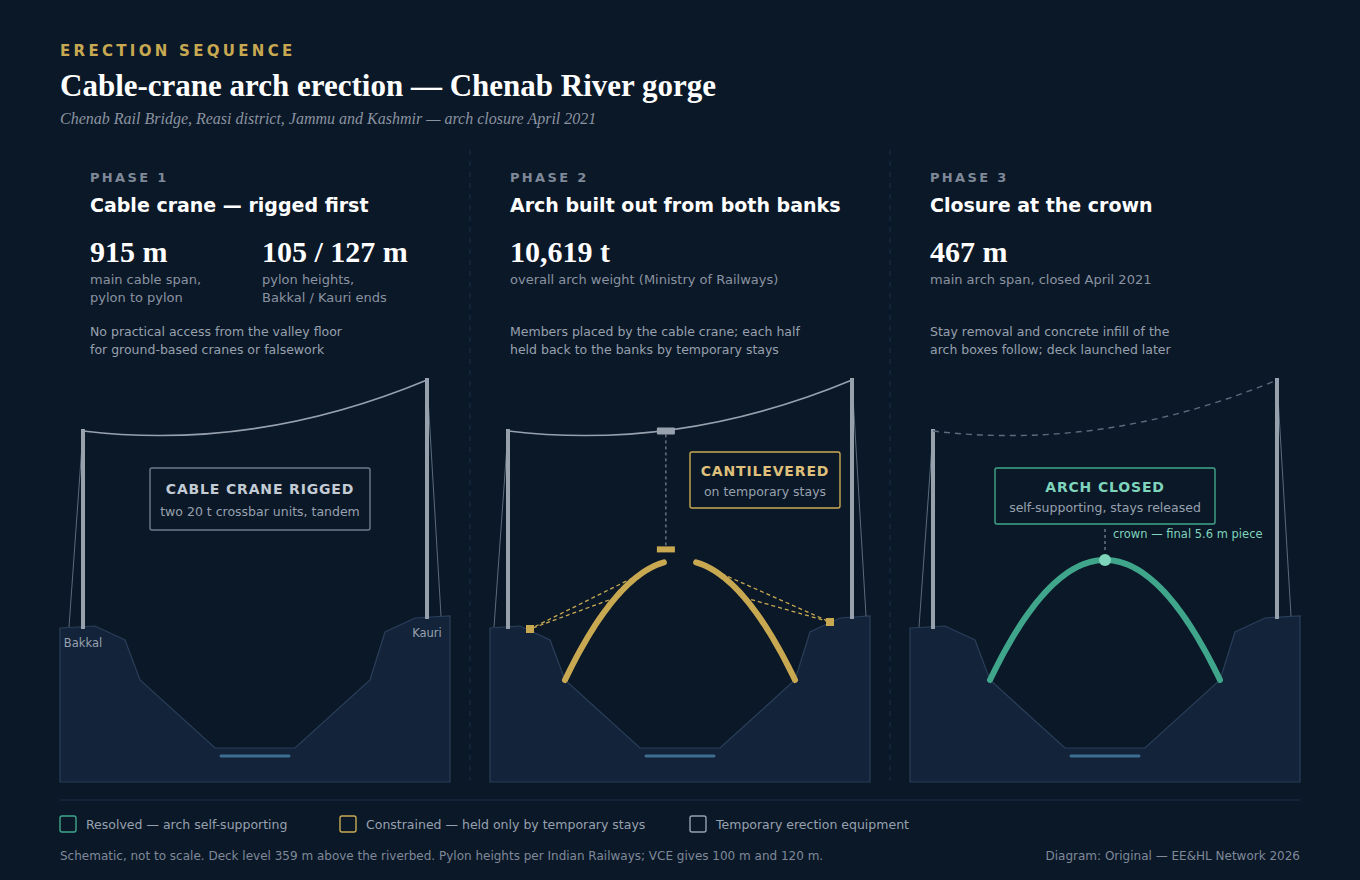
The answer was to build the erection system first, sized to this one crossing. Two guyed pylons were raised on opposite sides of the valley — approximately 127 metres at the Kauri end and 105 metres at the Bakkal end, according to Indian Railways’ Heritage Directorate — carrying main cables across a span of 915 metres. Indian Railways describes it as the longest-span cable crane in the world. Two crossbar systems ran side by side on those cables: Vienna Consulting Engineers (VCE), which carried out the detailed planning of the cable-crane systems, gives each a capacity of 20 tonnes on the hook, with the two able to work in tandem; Indian Railways cites a combined capacity of 34 tonnes in a single operation.
The bridge needed a crane. The gorge offered nowhere to stand one. So the crane became a structure in its own right — designed around a single crossing.
⚙️ Erection sequence — cable-crane arch erection, Chenab River gorge
Diagram: Original — EE&HL Network 2026. Schematic, not to scale. Pylon heights are as given by Indian Railways’ Heritage Directorate; VCE’s project page gives 120 m and 100 m. Figures are drawn from the sources listed below, not independently measured by EE&HL Network.
The arch was built in two halves, cantilevering out from each bank and held back by temporary stay cables, until the two arms met over the river. The Ministry of Railways dated arch closure to 5 April 2021, when the final 5.6-metre piece was fitted at the crown; WSP, the bridge’s design engineer, places the connection of the two halves in late March 2021. The arch is built from steel boxes, which the Ministry said would be filled with concrete to improve stability. It gave the arch’s overall weight as 10,619 tonnes, within 28,660 tonnes of steel fabricated for the bridge as a whole, and described the erection of the arch members by overhead cable cranes as a first on the Indian Railways network.
The cable crane did not simply disappear at closure. VCE describes the two systems as installed for the construction and the subsequent maintenance of the arch — a detail that complicates any reading of the crane as purely single-use plant.
For the full erection sequence, including the deck launch over the completed arch, see the Chenab Bridge case study.
💡 The Core Insight
This is not a story about a record-breaking height. It is an editorial reading of what happens to an erection method when the site will not allow a standard one — and of what a bridge takes on when its own crane has to be engineered before the bridge can be built. No method statement, contract document or cost breakdown for the cable-crane system was among the sources reviewed for this issue, and the analysis below should be read with that gap in mind.
The Pattern & The Question
What it costs to engineer erection plant around a single crossing — and three questions worth asking before specifying bespoke plant over rented capacity.
Sections 2 and 3 are delivered free by email. Subscribe below and they land in your inbox now.
Project owner / client sourceCrossing the Chenab: the world’s highest rail bridge — Heritage Directorate, Indian Railways, via Google Arts & Culture. Source for the approximate 127 m (Kauri) and 105 m (Bakkal) pylon heights, the 34-tonne combined lifting capacity and the longest-span description.
Secondary referenceArch closure of the Chenab Bridge — Ministry of Railways statement — India Infra Hub, April 2021. Reproduces the Ministry’s statement: the 5.6 m final piece, 10,619 MT arch weight, 28,660 MT of steel and the first use of overhead cable cranes for arch erection on Indian Railways.
Designer / engineering consultant sourceChenab Bridge — Cable Crane — Vienna Consulting Engineers. Source for the 915 m cable span, the 20-tonne crossbar units operable in tandem, and the cable crane’s role in construction and subsequent maintenance. Gives pylon heights of 120 m and 100 m.
Secondary referenceChenab Rail Bridge — overview — Wikipedia. Secondary source for the design and construction firms and the opening date.
Source labels describe provenance and relationship to the subject, not authority. A source is primary evidence of what its publisher stated, not independent confirmation that every statement is complete or correct. See the editorial methodology.
Marco Torri
Founder and Editor, EE&HL Network · Commercial intelligence for erection engineering & heavy lift