SSCV Thialf alongside the Perdido spar after the single-lift topsides installation, Gulf of Mexico, 2009. Photo: BoH, Wikimedia Commons, licensed CC BY-SA 3.0. Resized and format-converted for the web.← All Issues
Section 01✓ Free
The Project
118
feet
Hard-tank outer diameter
555
feet
Overall hull length
7,820
feet
Water depth at the spar
9,773
short tons
Single-lift topsides
Perdido spar, Alaminos Canyon Block 857, US Gulf of Mexico. Operator: Shell, with Chevron and BP. Spar and mooring EPC: Technip (hull fabricated at Pori, Finland). Topsides: Alliance Engineering (design), Kiewit Offshore Services, Ingleside (fabrication). Dry transport: Dockwise, Mighty Servant 1. Transport and installation: Heerema Marine Contractors — DCV Balder (hull and moorings), SSCV Thialf (topsides).
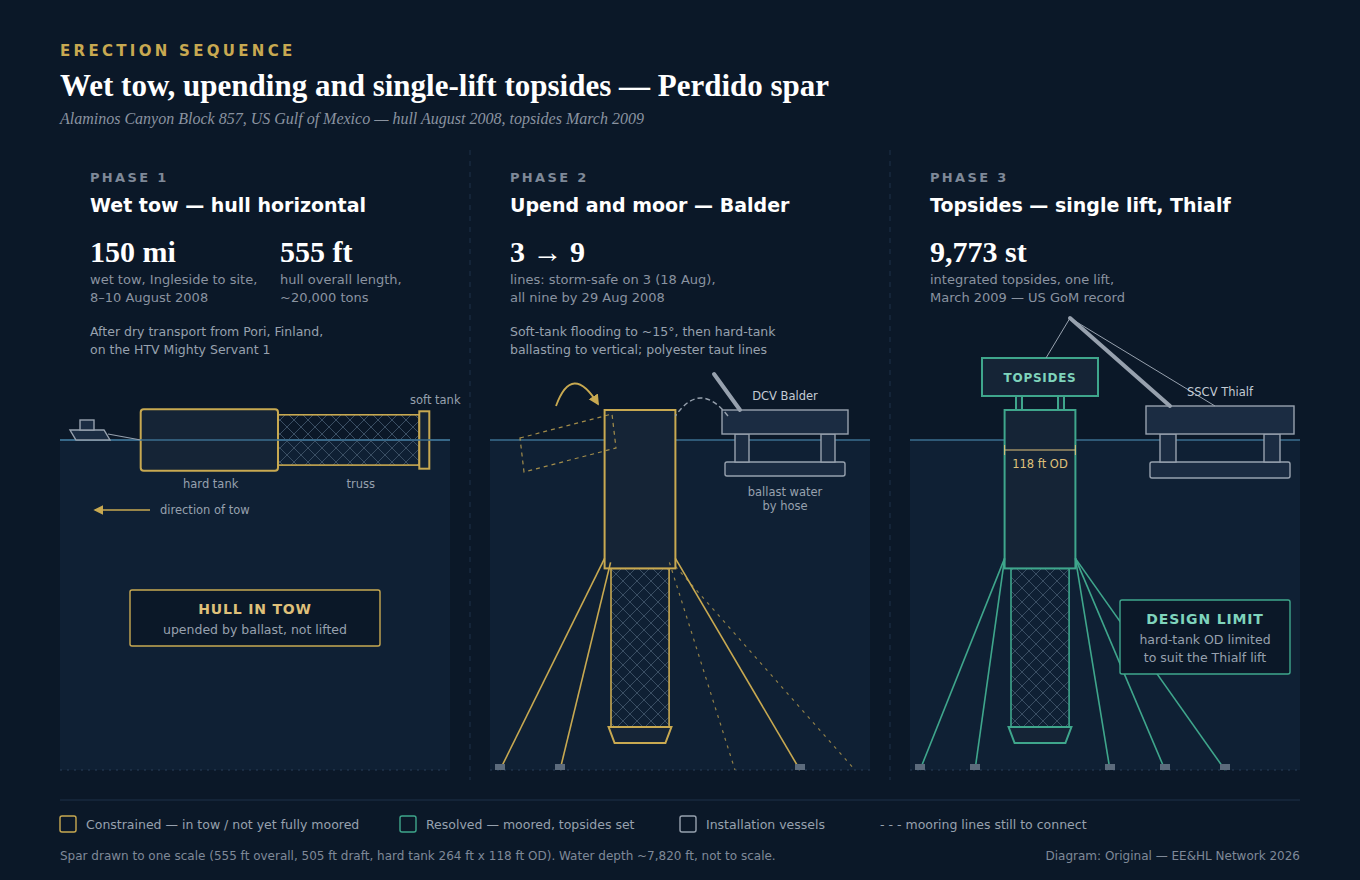
Shell’s Perdido spar floats in about 7,820 feet of water at Alaminos Canyon Block 857, in the far western Gulf of Mexico close to the maritime boundary with Mexico. Heerema Marine Contractors, which installed it, described it as the deepest spar ever installed. Its hard tank — the cylindrical upper hull that carries the topsides — has an outer diameter of 118 feet, a figure Shell’s project accounts present as a balance: small enough to allow Heerema’s SSCV Thialf to install the topsides offshore, yet large enough to provide the required buoyancy and to contain the platform’s liquid storage tanks.
That constraint entered the design early. Shell’s topsides lead has said the deck was designed in 2005 to match Thialf’s lifting capability, with the goal of installing the topsides in one piece and keeping them under about 10,000 tons, rather than the three modules a development of this size would otherwise have needed. The Shell paper on the spar and moorings describes the hull as designed to accept a single-lift topsides by limiting its diameter to 118 feet and placing storage tanks for diesel, methanol and other liquids inside the hull rather than on the deck. Heerema was named transport and installation contractor in spring 2006 — a step Shell’s own account describes as critical, because the spar and topsides had to be designed around the capacities of the available vessels.
The hull was built by Technip at Pori, Finland, and carried some 8,200 miles on Dockwise’s heavy transport vessel Mighty Servant 1 to Kiewit Offshore Services’ yard at Ingleside, Texas. After about a month and a half of outfitting there, it sailed on 8 August 2008 for a 150-mile wet tow, reaching the field two days later. Tugs opened plugs in the soft tank to bring the hull to an incline of roughly 15 degrees; ballast water pumped from Heerema’s DCV Balder through hoses then brought it upright, about three and a half days after operations began. Three mooring lines had been pre-installed and suspended from buoys; once they were connected, the spar was storm-safe on 18 August. The remaining six lines of the nine-line polyester taut mooring were installed by 29 August — just ahead of Hurricane Gustav.
The installation vessel had already shaped the hull’s geometry before the hull ever left the yard.
In March 2009, Thialf set the 9,773-short-ton integrated topsides in a single lift — at the time, the heaviest made in the US Gulf of Mexico. The topsides sailed from Ingleside on 8 March; the lift was completed on 13 March, and the living quarters followed three days later.
Diagram: Original — EE&HL Network 2026. Spar proportions drawn to one scale from published dimensions; water depth and vessel sizes not to scale. Figures are drawn from the sources listed below, not independently measured by EE&HL Network.
Two further choices read as commercial decisions carried in engineering form. The polyester-and-chain mooring was selected to place less vertical load on the floating structure than an all-steel system would — a permanent design choice with an installation-phase payoff, not an installation-only one. And the hurricane-season sequencing, planned according to published accounts with statistical weather data and probability estimates for weather contingencies, governed when the hull reached a defensible storm-safe condition rather than anything in the structure’s geometry.
Each constraint answers a different question. But all three — the crane’s lift envelope, the mooring material and the weather window — required the same thing: coordination between design, construction planning and the available offshore installation equipment, arranged years ahead of the campaign itself.
The hard-tank diameter reads as a negotiated design boundary rather than a purely operational one: narrow enough for Thialf’s single-lift installation, wide enough for buoyancy and storage. The 2005 decision to design the topsides around Thialf’s lifting capability shows the installation vessel entering the permanent design basis years ahead of the offshore campaign. This is an editorial reading of published project accounts; no contract documents or vessel-selection records were among the sources reviewed.
The Pattern & The Question
Why a single named vessel’s lift envelope becomes a permanent design constraint — and the three questions to put on your own erection-phase risk register.
Sections 2 and 3 are delivered free by email. Subscribe below and they land in your inbox now.
Industry pressBuilding the world’s deepest drilling and production platform — Oil & Gas Journal, April 2010. Source for the 118 ft hard-tank rationale, the 555 ft length and 20,000-ton hull weight, the spring 2006 Heerema appointment, the Ingleside outfitting, the 8 August sail-out and 150-mile tow, the 18 August storm-safe milestone, the 29 August completion ahead of Hurricane Gustav, and the lighter polyester lines.
Industry pressFabricating the single-lift topsides — Oil & Gas Journal. Source for the 2005 decision to design the deck around Thialf’s lift capability, the 9,773-short-ton lift and the March 2009 dates.
Technical / academic sourcePerdido Development Project — Spar and Moorings — Journal of Petroleum Technology synopsis of OTC 20885 (Lohr and Smith, Shell). Source for the diameter limit to accept a single-lift topsides, the in-hull storage tanks and the lower vertical load of the polyester/chain mooring.
Specialist contractor sourceInstallation of the world’s deepest spar — Heerema Marine Contractors, via Offshore Magazine, March 2010. Source for the 7,820 ft water depth, the upending method, the buoy-suspended pre-installed mooring lines and the Gulf of Mexico lift record.
Source labels describe provenance and relationship to the subject, not authority. A source is primary evidence of what its publisher stated, not independent confirmation that every statement is complete or correct. See the editorial methodology.
Marco Torri
Founder and Editor, EE&HL Network · Commercial intelligence for erection engineering & heavy lift