WilkinsonEyre/Gifford design, selected 1997. Steelwork: Watson Steel, Bolton. Assembly location: AMEC works, Hadrian Road, Wallsend. Main contractor: Harbour & General/VolkerStevin. Erection: 20 November 2000, via Asian Hercules II.
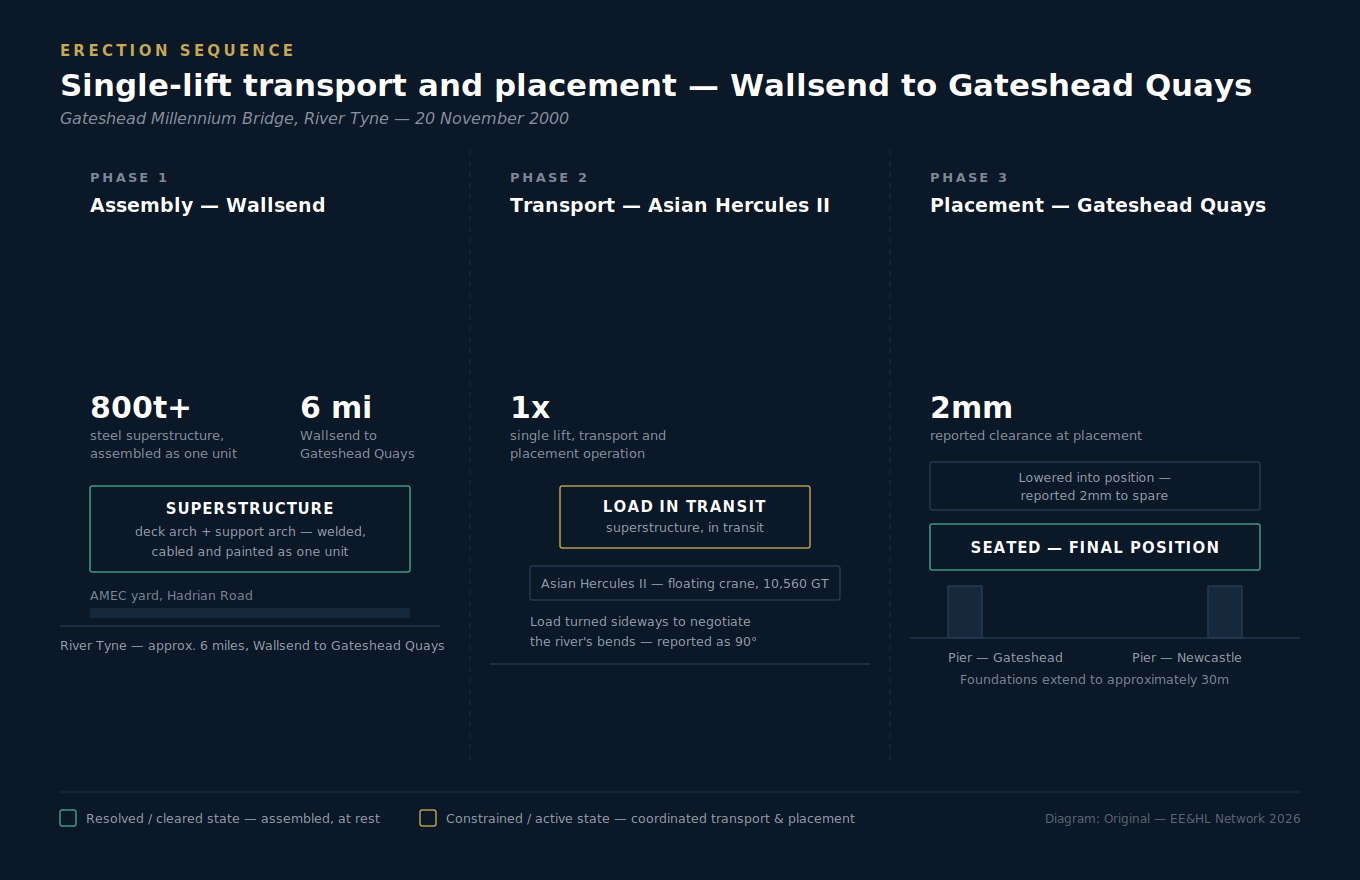
⚙️ Erection sequence — single-lift transport and placement, Wallsend to Gateshead Quays
Diagram: Original — EE&HL Network 2026. Figures shown are drawn from the sources listed below; the 90° rotation is as described in secondary accounts of the project, and the 2mm clearance is as reported by Gateshead Council, not values independently measured by EE&HL Network.
The Gateshead Millennium Bridge connects Gateshead's south bank to Newcastle's Quayside across the River Tyne. It is a pair of steel arches — one carrying the footpath and cycleway, the other a supporting parabolic arch whose crown stands about 50m above the river in the closed position — tied together by supporting cables and pivoting together around a shared springing point. When it opens, the entire structure rotates through 40 degrees: the curved deck rises while the supporting arch moves downward. It has been described as the world's first tilting footbridge, and it has since been nicknamed the Blinking Eye. The rotation is driven by an electro-hydraulic system combining electric motors and six hydraulic rams, three per side — public accounts describe both eight motors and six rams as components of the same system, though the precise motor-to-ram configuration isn't something the sources reviewed for this issue establish. The rotation completes in as little as four and a half minutes, depending on wind speed.
The main steel superstructure was not assembled at the crossing. It was fabricated at Watson Steel's works in Bolton, then shipped to AMEC's works at Hadrian Road in Wallsend, six miles downstream of the final site. There, the main steel superstructure was assembled as a single unit — both arches, the deck, the supporting cables, coated in weather-resistant paint — before it was transported across the river it was built to span. The concrete piers themselves, with foundations extending to approximately 30m, were built at the crossing site itself, ahead of the superstructure's arrival.
The steel superstructure was built everywhere except where it needed to stand.
On 20 November 2000, the finished assembly was carried by Asian Hercules II — described by Gateshead Council as Europe's largest floating crane at the time, a vessel of 10,560 GT — that is the hull's gross tonnage, not its lifting capacity, which is rated at 3,200 tonnes — with lifting legs over 350ft tall — six miles up the Tyne. Gateshead Council records that the deck had to be turned sideways to pass the river's bends; secondary accounts of the project, including the bridge's Wikipedia entry, put that rotation at 90 degrees. At the site, it was lowered onto the two piers, which Gateshead Council reports came to rest with around 2mm to spare.
The completed bridge underwent its first public tilt on 28 June 2001, watched by 36,000 people on the banks. It opened to the public on 17 September 2001 and was formally dedicated by Queen Elizabeth II on 7 May 2002. It went on to win the RIBA Stirling Prize (2002) and the IStructE Supreme Award for Structural Excellence (2003), recognising the design. The erection method that got the superstructure into position in one piece is a separate story from the design that won those awards.
💡 The Core Insight
This is not a story about a bridge that opens. It is an editorial reading of an erection method that combined offsite assembly, a single river transport, and a tightly toleranced placement into one coordinated operation — and what follows is that reading, not a documented account of contractor decision-making. No method statement, charter agreement, or contingency plan for this project was among the sources reviewed, and the analysis below should be read with that gap in mind.
The Pattern & The Question
What offsite single-lift erection actually trades off commercially — and the three questions to put on every concentrated transport-and-placement operation.
Sections 2 and 3 are delivered free by email. Subscribe below and they land in your inbox now.
Project owner / client sourceGateshead Millennium Bridge — delivery and opening — Gateshead Council. Source for the 2mm clearance, the sideways passage, the six-mile river transport and the Asian Hercules II particulars.
Project owner / client sourceGateshead Millennium Bridge — facts — Gateshead Council. Source for the 50m arch height above the river, eight electric motors, 4½-minute tilt, 30m foundations and the 800-tonne weight.
Technical / academic sourceGateshead Millennium Bridge — case study — SteelConstruction.info, Steel Construction Institute / BCSA. States a placement tolerance of ±2 mm, which is a design tolerance and not the same claim as the Council’s reported 2 mm of clearance at seating.
Secondary referenceGateshead Millennium Bridge — overview — Wikipedia. Secondary source for the 90-degree rotation, which Gateshead Council describes only as the deck being turned sideways.
Source labels describe provenance and relationship to the subject, not authority. A source is primary evidence of what its publisher stated, not independent confirmation that every statement is complete or correct. See the editorial methodology.
Marco Torri
Founder and Editor, EE&HL Network · Commercial intelligence for erection engineering & heavy lift