The Koror–Babeldaob Bridge linked the islands of Koror and Babeldaob in Palau. When it was completed in 1977 its 241 m main span was the longest of its type in the world: a prestressed concrete single-cell box girder, cast in place by the balanced cantilever method, with side spans of about 72 m. The two cantilevers met at a permanent midspan hinge rather than a moment-continuous connection, so each half of the main span stayed a cantilever for the life of the original structure.
The bridge is remembered for how it ended. Its midspan kept sagging for nearly two decades. A retrofit completed in July 1996 closed the hinge and added external post-tensioning, and on 27 September 1996 the main span collapsed. The investigations that followed are a record of long-term behaviour and of what happens when a structural system is changed late in its life. This page summarises what the published sources say; it does not offer a new finding on the cause.
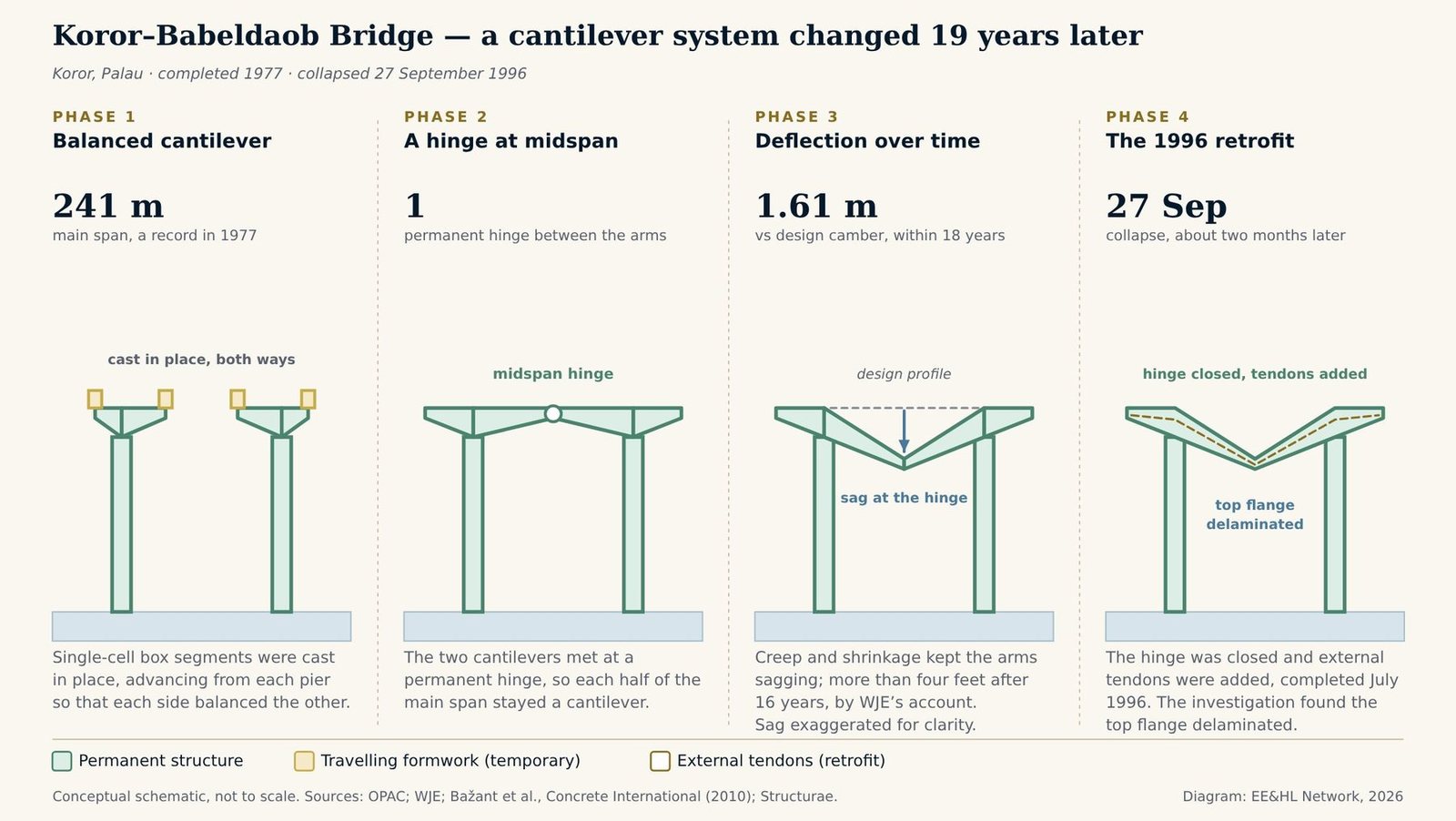
Sources: OPAC; WJE; Bažant et al., Concrete International (2010); Structurae. Diagram: EE&HL Network, 2026.
Tap or click the diagram to open it full size.
The retrofit did not add a new structure to the bridge. It changed the structure the bridge already was, from two cantilevers meeting at a hinge to one continuous span, after nearly twenty years of behaving as the first.
WJE’s published summary gives the mechanism in more detail. Closing the hinge substantially increased the compressive stress in the top flange and introduced daily, temperature-induced variations in that stress. Contributing factors included closely spaced tendons, a lack of vertical reinforcement and low tensile strength in the concrete; WJE notes that carbonation-related corrosion may also have contributed. WJE also states that the estimated stresses due to the retrofit were within normally accepted limits. Read together, WJE’s published findings describe a vulnerable top flange subjected to increased compression after the structural system changed. That is an editorial reading of the sources, not a finding of this site.
Two threads run through the case for erection engineering. The first is long-term behaviour: the construction method and the permanent hinged configuration shaped how the structure would creep and deflect for decades afterwards, and, according to Bažant and co-authors, the prediction models of the day did not capture it. The second is the change of structural system. A load path that changes, here from cantilever to continuous beam, is the same kind of transition that erection sequences pass through during construction, and the same question applies: which parts of the structure take the new load, and were they checked for it?
For the construction method, see What Is Balanced Cantilever Construction? and What Is Erection Sequence Risk?. For the general case of load moving from one system to another, see the insight Why the Transition Can Be Riskier Than the Lift. A replacement bridge opened in January 2002; it is not covered here.
Related case studies: Krk Bridge · Skarnsund Bridge · Sidu River Bridge · Woronora River Bridge · Pelješac Bridge
Core concepts: What is erection engineering? · What is heavy lift engineering?

Photo: Trust Territory of the Pacific Islands Headquarters, via Wikimedia Commons; public domain (work of the U.S. Department of the Interior).
Sources: OPAC Consulting Engineers — project page — completion in 1977, spans, single-cell box, cast-in-place balanced cantilever, record span; WJE — Koror-Babeldaob Bridge project page — deflection after 16 years, retrofit, collapse on 27 September 1996, investigation with T. Y. Lin for the Republic of Palau, top flange delamination, temperature-induced stress variation and contributing factors; Concrete International — Bažant, Z. P., Yu, Q., Li, G.-H., Klein, G. J. and Křístek, V., “Excessive Deflections of Record-Span Prestressed Box Girder”, vol. 32, no. 6, 2010 — 1.61 m deflection within 18 years, model underestimation; Structurae — dates, collapse on 27 September 1996, casualties. Structurae gives the completion year as 1978; the engineer’s account gives 1977, which is used here. The collapse date of 27 September 1996 is WJE’s; some reports give 26 September. Structurae reports two deaths and four injuries in the collapse. Side spans are given as about 72 m in the sources reviewed. The cause summary above is WJE’s published account; other analyses of the collapse exist and are not reviewed here. An earlier version of this story appeared as a LinkedIn post.
Frequently Asked Questions
According to WJE, which investigated with T. Y. Lin for the Republic of Palau, the trigger was delamination of the top flange. Closing the midspan hinge during the 1996 retrofit substantially increased the compressive stress in the top flange, with daily temperature-induced variations, and contributing factors included closely spaced tendons, a lack of vertical reinforcement and low tensile strength in the concrete. WJE states that the estimated stresses due to the retrofit were within normally accepted limits.
Bažant and co-authors, writing in Concrete International in 2010, report a total midspan deflection of 1.61 m relative to the design camber within 18 years. WJE describes more than four feet of deflection after 16 years.
A year-long retrofit, completed in July 1996, closed the permanent hinge at midspan and added continuous external post-tensioning tendons, so the main span became continuous rather than two cantilevers. The bridge collapsed on 27 September 1996.
It was a prestressed concrete single-cell box girder cast in place by the balanced cantilever method, with a 241 m main span and side spans of about 72 m. The two cantilevers met at a permanent hinge at midspan. Its main span was described as a world record for this type of structure when it was completed in 1977.