Governor Mario M. Cuomo Bridge, built as the New NY Bridge, replacing the Tappan Zee Bridge across the Hudson River, New York. Twin-span crossing about 3.1 miles long. Design-builder: Tappan Zee Constructors (Fluor, American Bridge, Granite, Traylor Bros.). Original design-build award: $3.142 billion, December 2012.
The Tappan Zee Bridge opened in 1955, about 20 miles north of Manhattan. By 2012 it carried around 138,000 vehicles a day, roughly 40% more than it was designed for. Its replacement would be a twin-span crossing about 3.1 miles long, with eight traffic lanes and a 1,200-foot main span.
It was the New York State Thruway Authority’s first design-build project, following the state’s 2011 design-build legislation. Under design-build, the owner sets the requirements and the competing teams develop both the design and the way it will be built. Selection used a best-value process combining technical and other criteria with price. Three teams bid.
On 17 December 2012 the Thruway board selected Tappan Zee Constructors (TZC), a joint venture of Fluor, American Bridge, Granite and Traylor Bros. Its price was $3.142 billion. Tappan Zee Bridge Partners, the Bechtel-led team, bid $3.990 billion. Kiewit–Skanska–Weeks bid $4.059 billion. The design-build price was the largest part of the $3.981 billion project budget established at commencement.
Team
Bid price
Proposed dredging (cu yd)
Proposed piles
Proposed duration
Tappan Zee Constructors
$3.142B
951,000
964
5 yrs 2.5 mos
Tappan Zee Bridge Partners (Bechtel-led)
$3.990B
1,800,000
1,387
5 yrs 11.5 mos
Kiewit–Skanska–Weeks
$4.059B
1,550,000
1,392
5 yrs 11 mos
Source: Thruway Chairman Howard P. Milstein’s bid comparison, 20 December 2012. Proposal quantities and durations, not as-built totals.
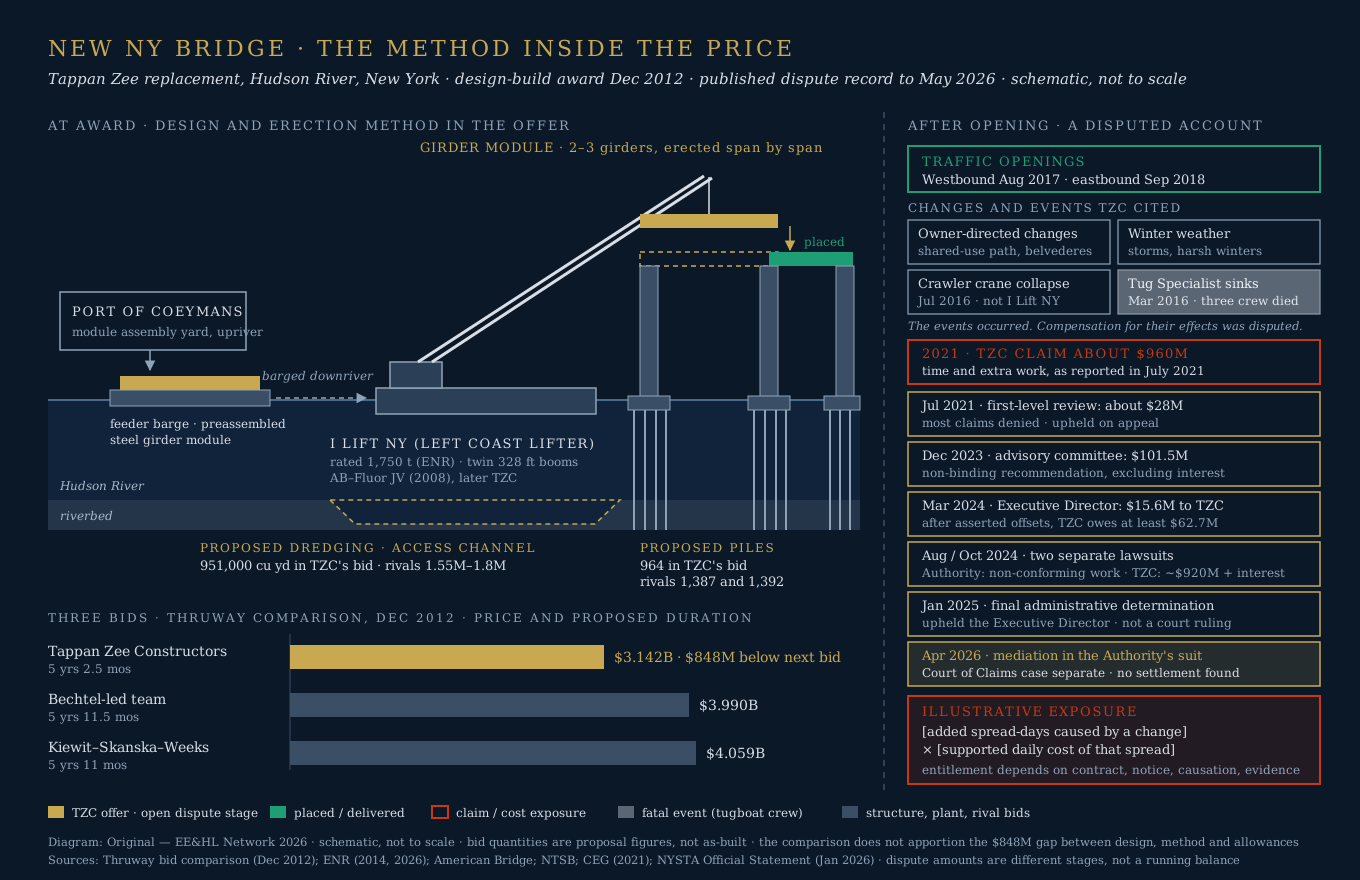
TZC proposed 951,000 cubic yards of dredging against its rivals’ 1.55 and 1.8 million. It also proposed about 30% fewer piles and a programme 8.5 to 9 months shorter. The dredging was for an access channel, to “safely bring in and maneuver marine equipment for construction,” in the words of the Army Corps of Engineers’ public notice. Fluor said its design “reduced the weight of the structure and minimized the number and size of foundations required.” Those quantities came from one combined design and construction proposal. The published comparison does not divide the $848 million between design, foundations, marine access, erection, programme and commercial allowances.
Modular erection was a large part of the construction strategy. Approach girders were assembled into two- and three-girder modules at the Port of Coeymans upriver, barged down the Hudson and erected span by span. ENR reported in 2014 that some 130 modules were planned, up to 400 feet long, with catwalks, electrical and plumbing already fitted. American Bridge’s project account confirms the two- and three-girder assemblies, utilities installed at Coeymans and the barge route to the crossing. It also describes how the team’s steel superstructure and bearings reduced demand on the foundations.
The crane was the Left Coast Lifter, nicknamed I Lift NY on the Hudson. The ZPMC-built floating crane, which ENR described as a $50 million machine, was bought in 2008 by an American Bridge–Fluor joint venture for the San Francisco–Oakland Bay Bridge. ENR reported that ownership later passed to TZC, and gave its rating as 1,750 tonnes, with twin 328-foot booms. It went through the Panama Canal earlier in 2014, was recommissioned in Jersey City and reached the site on 6 October 2014. TZC’s construction manager told ENR that conventional girders would have needed “a fleet of many more barges.”
The owner was not only comparing prices. It was comparing ways of building.
⚙️ New NY Bridge — the method inside the price
Diagram: Original — EE&HL Network 2026. Schematic, not to scale. Bid quantities are proposal figures, not as-built; the comparison does not apportion the $848M gap between design, method and allowances. Dispute amounts are different stages, not a running balance. Tap or click the diagram to open it full size.
The contract was fixed-price and date-certain. ENR reported in 2013 that it carried delay charges of $120,000 a day. It also carried lane-closure charges of $1,500 per lane per minute if fewer than four lanes were open in rush hour. The bridge was designed for a 100-year service life. Those terms put substantial delivery risk on TZC. They worked alongside the contract’s change and dispute procedures, not in place of them.
Westbound traffic moved onto the new bridge in August 2017, and the eastbound span opened in September 2018. Opening the bridge and closing the commercial account turned out to be different milestones.
From 2018, TZC submitted claims for time and extra work. In July 2021, reporting put the total at about $960 million. TZC cited owner-directed changes, including the shared-use path and its six belvederes. Reporting said the belvederes rose from a $2.45 million plan to $64 million after the Thruway asked for glass-walled overlooks. TZC also cited winter weather and two incidents in 2016. In March, the tugboat Specialist struck a construction barge spudded down at the site and sank, and its three crew members died. In July, a barge-mounted crawler crane, not I Lift NY, collapsed onto the old bridge. The events occurred. Compensation for their effects was disputed.
July 2021 reporting described about $28 million accepted at the first level of the Thruway’s administrative review. That was mainly for dredged-material disposal after an initial plan fell through. The review denied most of the remaining claims, citing lack of merit, notice requirements and failure to show causation of supported damages. A second tier upheld that result. TZC then took the dispute to the executive director, who sought a non-binding recommendation from an independent advisory committee under the contract. In December 2023 the committee recommended $101.5 million, excluding interest. In March 2024 the executive director instead found TZC entitled to $15.6 million. The same determination concluded that TZC owed the Authority at least $111.4 million for liquidated damages and remedial work. Allowing for a $33.1 million contract balance, it put TZC’s net liability at a minimum of $62.7 million. The Authority’s final administrative determination upheld this in January 2025. These were administrative decisions under the contract, not court rulings.
TZC had first sued in the Court of Claims in February 2021, seeking about $961 million; local reporting says it withdrew that suit months later while the administrative process continued. The dispute moved back into the courts in 2024, in two separate lawsuits. In August 2024 the Authority sued TZC, its affiliates and its sureties in State Supreme Court over alleged non-conforming work. That work includes anchor pipes that ENR reported affect 61 of the 192 stay cables. The Authority says the bridge is safe and puts preliminary remediation at $45 million to $80 million. In October 2024 TZC sued in the Court of Claims for about $920 million plus interest. ENR reported in May 2026 that TZC was seeking about $930 million in unpaid costs. It also reported April mediation in the Authority’s Supreme Court case; the Court of Claims payment case remained separate. We found no published settlement as of 9 October 2026. The amounts above come from different stages and claim bases. They are not one running balance.
This is not a story about one of the largest floating cranes in the world, and it does not claim that one crane produced an $848 million gap. It is about what a design-build price contains, and what has to be proven when part of it is later disputed.
TZC’s bid sat $848 million below the next. The published comparison shows the physical difference behind it: less dredging, fewer piles and a programme 8.5 to 9 months shorter. Modular erection with a crane its partners already owned was part of that offer, alongside a lighter structure and smaller foundations. The record does not isolate the crane’s share. It does show that the owner chose a design, a method and a price together. In 2026, nine years after the first span opened, the parties were still contesting what was required, what changed and who should pay.
⚙️ New NY Bridge · Procurement to dispute (published record)
2011New York enacts design-build legislation.
Mar 2012Request for proposals issued. Three teams bid.
17 Dec 2012TZC selected at $3.142B.
6 Oct 2014I Lift NY reaches the site.
12 Mar 2016Tugboat Specialist strikes a construction barge and sinks. Three crew members die.
Jul 2016A separate crawler crane collapses onto the old bridge.
Aug 2017 / Sep 2018Westbound and eastbound traffic openings.
2018 onwardTZC submits claims for time and extra work.
Feb 2021TZC files suit in the Court of Claims, later withdrawn.
Jul 2021Reporting describes about $28M accepted; most disputed claims rejected. The rejection was upheld on administrative appeal.
Dec 2023Advisory committee recommends $101.5M, excluding interest.
Mar 2024Executive director finds $15.6M due to TZC, and TZC owing at least $62.7M net.
Aug / Oct 2024Authority and TZC file separate lawsuits.
Jan 2025Final administrative determination upholds the executive director.
Apr 2026Mediation in the Authority’s Supreme Court case.
The Pattern & The Question
Why a design-build price carries its method’s assumptions, what the contract and the record decide when part of it is disputed — and three questions for your next pursuit.
Sections 2 and 3 are delivered free by email. Subscribe below and they land in your inbox now.
Owner sourceDesign-build plan approved by Thruway board for New NY Bridge — Thruway Chairman Howard P. Milstein, 20 December 2012. Source for the three bid prices, proposed dredging, piles and durations, the TZC joint-venture members and the 17 December 2012 board decision.
Contractor sourceGovernor Mario M. Cuomo Bridge project account — American Bridge. Source for the two- and three-girder assemblies, utilities fitted at Coeymans, the barge route and the lighter superstructure.
Industry pressLeft Coast Lifter Arrives at Tappan Zee Bridge — ENR, October 2014. Source for the 1,750-tonne rating, the twin 328-ft booms, the 2008 purchase, the transfer to TZC, the 6 October 2014 arrival, the 130 planned modules and the construction manager’s quote.
Industry pressTZC sues New York to prove it’s owed $900M — Construction Dive, 26 November 2019. A records (Freedom of Information Law) suit seeking documents to support TZC’s claims.
Owner disclosureSeries 2026A Official Statement, “Dispute with TZC” — New York State Thruway Authority, 8 January 2026. Source for the advisory committee recommendation, the executive director’s determination and its figures, the final administrative determination and the preliminary remediation range.
Source labels describe provenance and relationship to the subject, not authority. A source is primary evidence of what its publisher stated, not independent confirmation that every statement is complete or correct. See the editorial methodology.
Marco Torri
Founder and Editor, EE&HL Network · Commercial intelligence for erection engineering & heavy lift