NASA's crawler-transporter has been carrying rockets to the launch pad for six decades — and it does it at a top speed of roughly one mile per hour. That deliberate pace isn't a limitation; it's the entire point. Moving up to 18 million pounds safely means moving slowly enough to correct for anything before it becomes a problem.
Built in 1965 by the Marion Power Shovel Company specifically to carry the Saturn V rocket for NASA's Apollo program, the crawler now holds a Guinness World Record of its own: the heaviest self-powered vehicle ever built.
Roughly equivalent to 15 Statues of Liberty, moving at a deliberate one mile per hour — slow enough that engineers can correct for anything before it becomes a problem.
The NASA crawler-transporter stands as a reference case for heavy transport engineering built around patience rather than speed: a machine massive enough to be the heaviest self-powered vehicle on record, engineered to move even more massive cargo at a pace that trades urgency for absolute control over the load.
For further reading on specialized heavy transport methods, see What is Heavy Transport Engineering?
Related case studies: 39 Fizuli Street · Cape Hatteras Lighthouse · Refinery Combination Tower
Core concepts: What is erection engineering? · What is heavy lift engineering?

Photo: NASA, Wikimedia Commons, public domain.
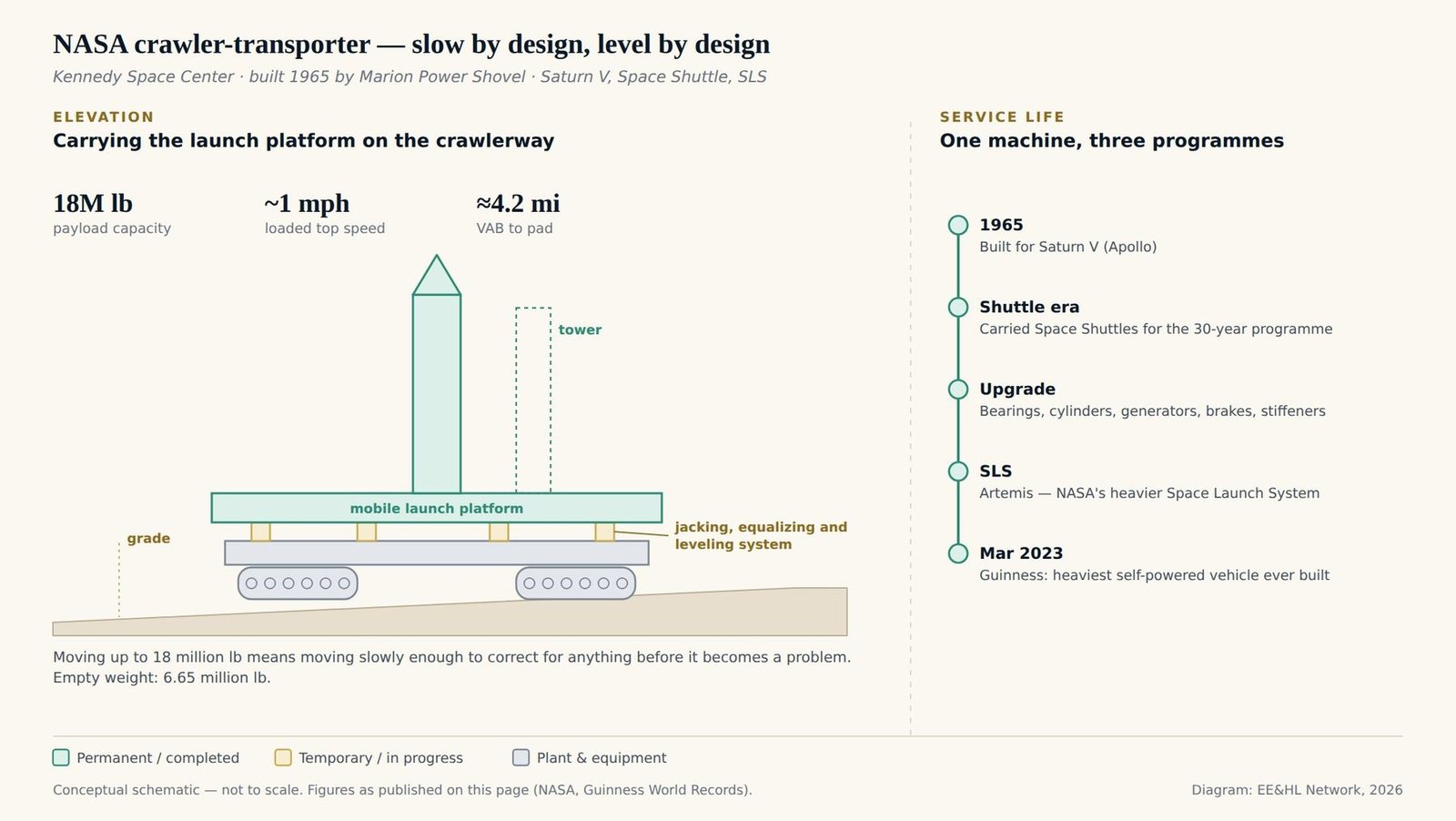
Diagram: EE&HL Network, 2026. Conceptual schematic — not to scale.
Tap or click the diagram to open it full size.
Sources: Guinness World Records — certified record for the heaviest self-powered vehicle: Crawler-Transporter 2 at 3,016 tonnes (6.65 million lb), following upgrades completed 23 March 2016; NASA — operator's record announcement and crawler history; Space.com — original as-built weight of roughly 2,700 tonnes before the Artemis-era upgrades. Guinness publishes the converted figure as both 3,016 and 3,106 tonnes; the underlying 6.65 million lb value is consistent. The record applies to Crawler-Transporter 2 specifically, not to both vehicles.
Frequently Asked Questions
Each crawler-transporter weighs approximately 6.65 million pounds empty and can carry payloads of up to 18 million pounds following upgrades made for NASA's Space Launch System program.
The crawler travels at a maximum of about 1 mile per hour when loaded and 2 miles per hour when unloaded, covering roughly 4.2 miles between the Vehicle Assembly Building and the launch pad at Kennedy Space Center.
NASA's two crawler-transporters were built in 1965 by the Marion Power Shovel Company specifically to move the Saturn V rocket for the Apollo program from the Vehicle Assembly Building to Launch Complex 39.
In March 2023, Guinness World Records officially certified Crawler-Transporter 2 as the heaviest self-powered vehicle ever built, at approximately 6.65 million pounds — roughly equivalent to 15 Statues of Liberty.