Knowledge · Offshore & Heavy Lift
What Is a Jacket Lift System?
A jacket lift system (JLS) is a bespoke lifting frame and structural interface that allows a heavy-lift vessel to remove or install a fixed steel jacket — the lattice substructure that carries an offshore platform's topsides — as a single lift. It replaces the traditional route of piled or grouted connections and a multi-stage removal or installation campaign with one controlled lifting operation.
Technical Scope
Why Jackets Resist Simple Lifting
A jacket's structural frame is designed to carry environmental and operational loads once it's piled or grouted into the seabed — not to carry its own weight as a single suspended lift. Lifting it whole introduces load paths, bending moments, and local stresses at the lift points that the original design never accounted for. Without added strengthening, a jacket lifted directly at its as-built connection points risks local structural failure well before it clears the water.
Interface Engineering
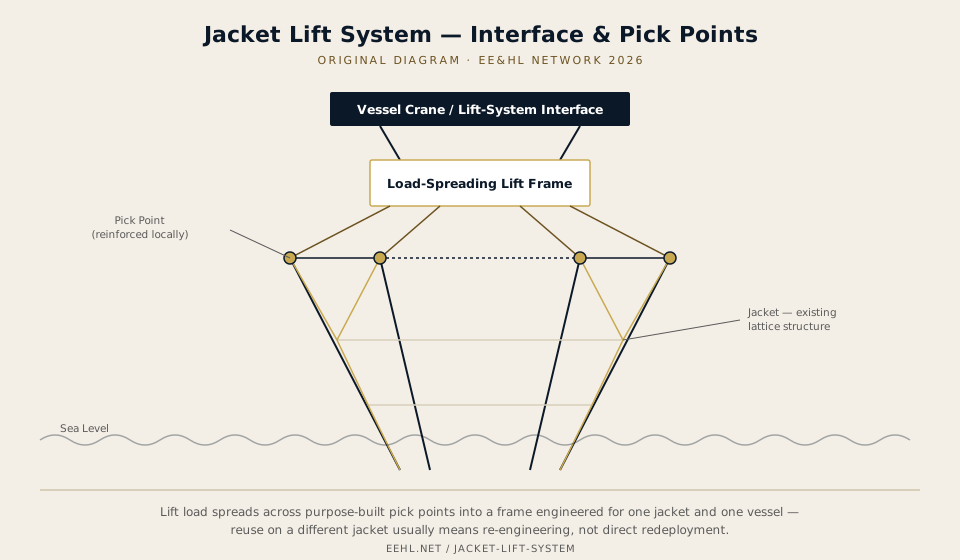
A JLS spreads the lift load across purpose-built pick points, often reinforcing the jacket's upper bracing locally and providing a structural frame that transfers load cleanly into the vessel's crane or lift-system interface. Every JLS is engineered around the specific jacket's as-built geometry and weight distribution — there's no standard off-the-shelf version.
Tap to enlarge
Jacket lift system — interface, pick points, load-spreading frame
Diagram: Original — EE&HL Network 2026
Vessel Compatibility
The JLS also has to match the specific heavy-lift vessel doing the work — its crane capacity and reach, or, for single-lift vessels designed around a fixed lift-system deck (the approach used on some of the largest topsides and jacket removals to date), the vessel's own lift-system geometry. A JLS engineered for one vessel class is not automatically compatible with another.
The Commercial Dimension
Because a JLS is matched to a specific vessel and a specific jacket geometry, it behaves commercially more like a purpose-built capital item than like hired plant. The pattern worth recognising follows from that: where a removal or installation campaign depends on lift-system hardware that is still being fabricated, the binding constraint is fabrication lead time rather than the lift operation itself — and a vessel held on standby for unfinished equipment is an expensive form of delay.
The paragraph above is editorial interpretation, not a documented finding. The sources listed below describe float-over installation and SPMT load-out engineering; the sources reviewed for this page do not establish fabrication lead times, procurement arrangements or reuse rates for jacket lift systems, and no manufacturer specification or project method statement for a specific JLS was available. Readers should treat the commercial reading as a hypothesis to test against their own project data.
Frequently Asked Questions
What is a jacket lift system used for?
It lets a heavy-lift vessel remove or install an offshore jacket as a single lift, rather than through piled or grouted connections requiring a separate multi-stage campaign.
Why can't jackets be lifted with a standard crane vessel interface?
Jackets are designed as permanent, piled or grouted structures, not to carry their own weight as a suspended lift. A JLS adds temporary strengthening and purpose-built lift points to survive a load condition the original design never accounted for.
How long does a jacket lift system take to fabricate?
The sources reviewed for this page do not establish fabrication durations for jacket lift systems. Lead time is a property of the individual contract, the fabricator and the vessel's campaign schedule, and would need to come from the project or the supplier.
Is a jacket lift system reusable across projects?
A JLS is engineered around one jacket's geometry and one vessel's interface, so it is not a general-purpose item. Whether and how often such systems are redeployed is not something the sources reviewed for this page establish.
Sources and further reading
- Technical / academic sourceState of the Art in Float-Overs (OTC-19072-MS) — Offshore Technology Conference / OnePetro.
- Technical / academic sourceReview on recent research and technical challenges of floatover installation — Ocean Engineering, Elsevier, 2022.
- Technical / academic sourceOptimization solutions for SPMT load-outs based on ballast simulation — Ocean Engineering, Elsevier, 2020.
Source labels describe provenance and relationship to the subject, not authority. A source is primary evidence of what its publisher stated, not independent confirmation that every statement is complete or correct. See the editorial methodology.