The Jamuna River in Bangladesh forms part of the Brahmaputra system, one of the largest river systems in the world by discharge volume. Within Bangladesh it has a flood width of up to 14 kilometres at the bridge site, with the full braided belt reaching up to 20 kilometres in places. It braids — flowing through dozens of shifting channels separated by temporary sand islands that move hundreds of metres in a single monsoon season. The riverbed beneath it is soft alluvial sand, kilometres deep, with no stable foundation layer reachable by conventional means.
In 1994, contracts were awarded to build a 4.8-kilometre bridge across it.
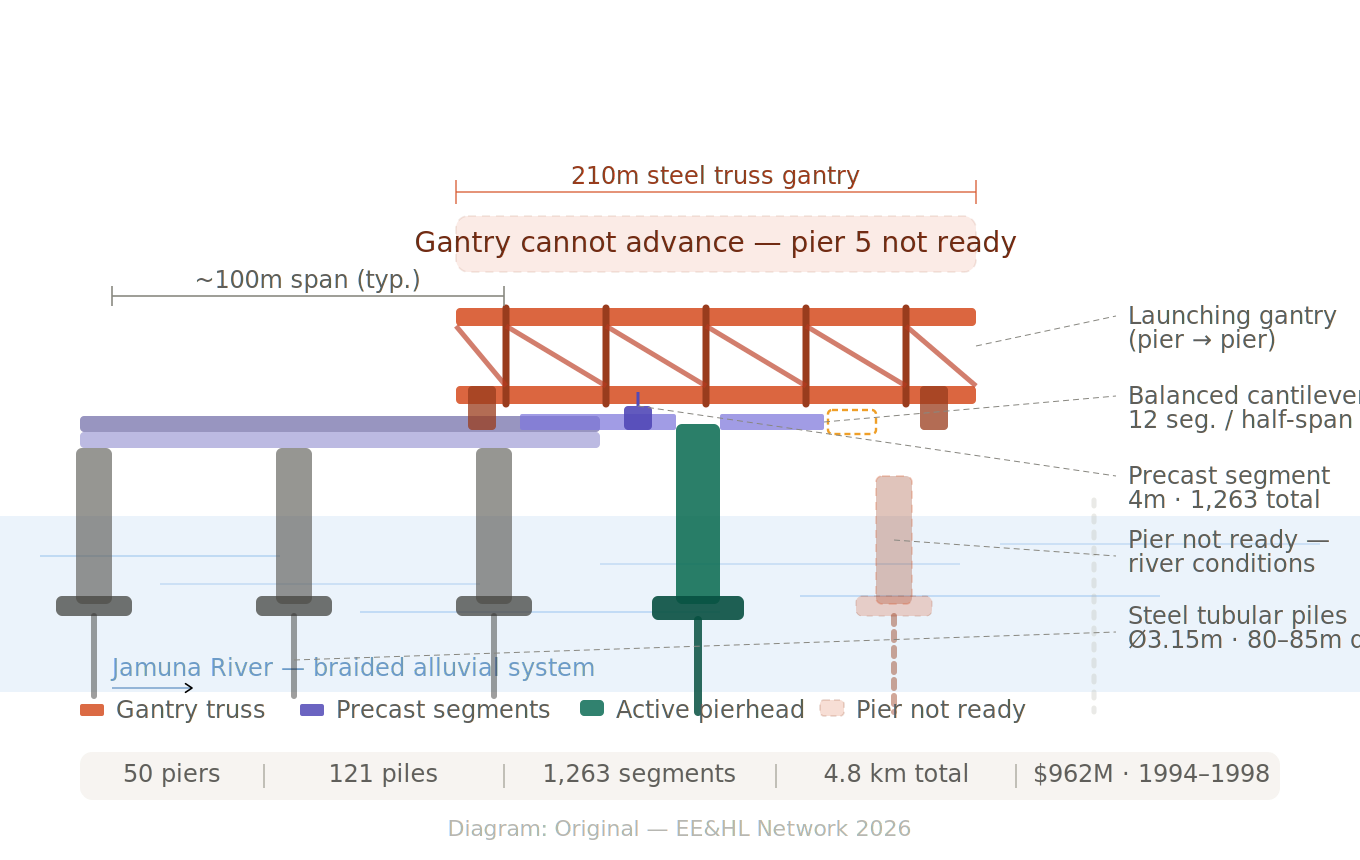
The numbers were immediately formidable. 50 piers. 121 steel tubular piles — up to 3.15 metres in diameter, driven 80 to 85 metres into a riverbed capable of liquefying under seismic load. Pile caps precast onshore, floated out on barges, positioned in up to 50 metres of flowing water, then infilled with concrete. Offshore piling technology — developed for North Sea conditions — adapted for a river. Pile driving started October 1995. It took 9 months to drive all 121 piles across a braided river that could not be stopped, diverted, or controlled. Only managed.
The superstructure erection used a 210-metre steel truss gantry (TYLin Group, designer of record; Butterley Engineering, the manufacturer, records ~200 m) advancing pier by pier across 49 spans. 1,263 precast segments — each 4 metres long — erected by balanced cantilever. Each cantilever: 12 segments from a pierhead. Each span: approximately 100 metres. 7 structural modules of roughly 700 metres each. Total construction period: October 1994 to June 1998. 3 years and 8 months.
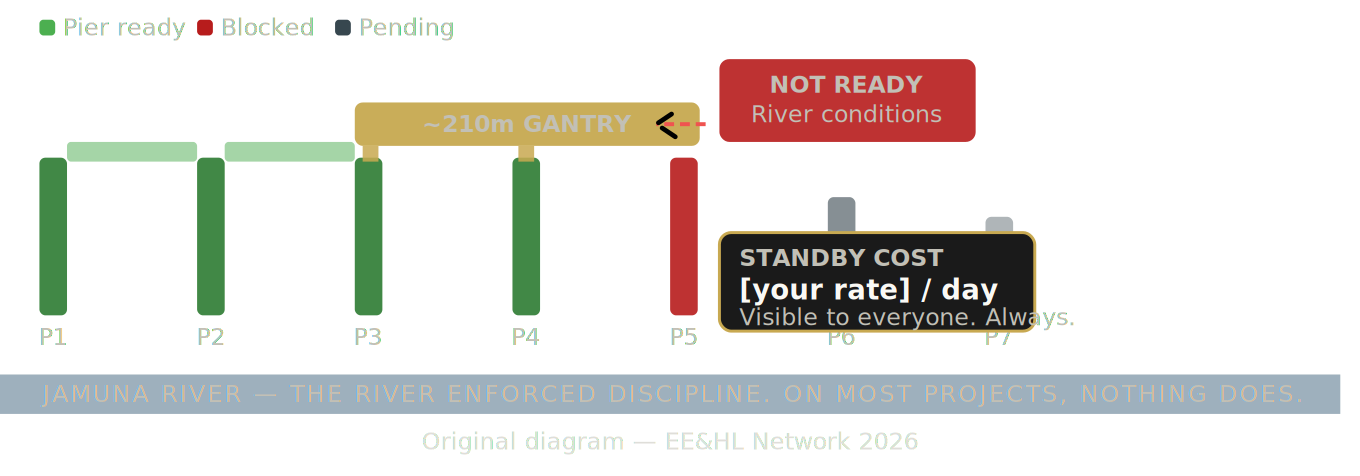
The gantry could not skip a pier. It could not work out of sequence. It could not advance until the next pier was ready to receive it — structurally complete, pile cap set, pier shaft constructed, pierhead formed and cured to specification.
And there was the problem — and the solution — simultaneously.
The river decided when each pier was ready. Not the programme. Not the contract.
The river.
If the barge carrying a pile cap could not hold position in the current, the pier waited. If scour eroded a previously certified founding level, the pier waited. If the monsoon closed the river to marine plant, every pier on the active front waited. And while each pier waited, the gantry waited. The daily cost of the gantry — mobilised, staffed, insured, financed — ran regardless.