Knowledge · Bridges & Segmental Construction
What Is Match-Casting?
Match-casting is a precasting technique where each new concrete segment is cast directly against the finished face of the segment before it, so the new segment's end face becomes an exact geometric mirror of the joint it will bear against once erected on site. It's the reason precast segmental bridges — including balanced-cantilever and incrementally-launched decks — can be assembled from dozens or hundreds of separately-cast pieces without accumulating fit-up error along the way.
Technical Scope
Short-Line vs Long-Line Casting
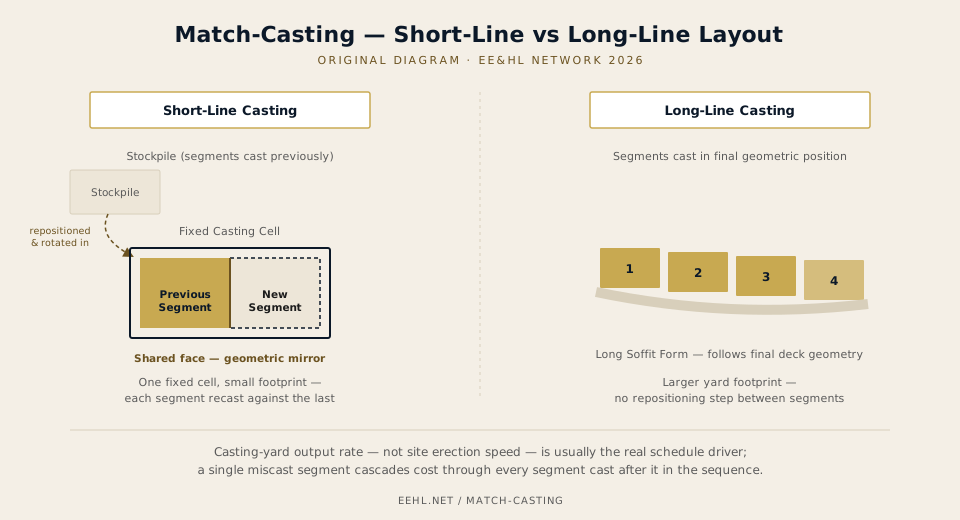
Two casting-yard layouts are used in practice. Short-line casting produces every segment in one fixed casting cell, rotating and repositioning each new segment against the previous one to simulate its final position before casting. Long-line casting instead casts every segment for a span in its actual final geometric position along a long soffit form, which removes the repositioning step at the cost of a much larger casting yard footprint.
Geometry Control
Because each segment is cast against the real, as-built face of its neighbour rather than to a fixed theoretical drawing, small deviations in one segment don't compound into the next — the sequence self-corrects. That doesn't remove the need for constant survey control: camber, twist, and cumulative alignment across dozens of segments still have to be tracked continuously, because an error caught early is a casting-yard adjustment, and an error caught late is a site erection problem.
Tap to enlarge
Match-casting — short-line vs long-line casting layout, segment face geometry
Diagram: Original — EE&HL Network 2026
Joint Behaviour
Match-cast joints are closed in one of two ways: epoxy-jointed, where a thin epoxy layer provides both waterproofing and additional shear/load transfer across the joint, or dry-jointed, relying on shear keys and post-tensioning alone. The choice affects erection rate directly — epoxy has a cure-time window that constrains how fast segments can be stacked, while dry joints remove that constraint at the cost of relying entirely on mechanical shear-key transfer and post-tensioning force.
The Commercial Dimension
The intuitive assumption is that a segmental bridge's schedule is set by how fast segments go up on site. In practice it's usually set by how fast the casting yard can turn out geometrically correct segments — site erection is often the faster half of the process once segments exist. That reframes casting-yard quality control from a background QA function into the actual commercial risk driver: a single miscast segment doesn't just cost a re-cast, it can cascade delay and rework cost through every segment cast after it in the sequence, because match-casting only self-corrects locally, against the immediately preceding face — not against the original design geometry for the whole span.
Frequently Asked Questions
What does match-casting mean in bridge construction?
Casting a new segment directly against the finished face of the previous one, so the new face is an exact geometric mirror of the joint it will bear against once erected — eliminating on-site fit-up tolerance issues.
What's the difference between match-casting and ordinary precasting?
Ordinary precasting produces standardised units to a fixed drawing. Match-casting produces segments that are each geometrically unique, cast against the actual as-built face before them, so the sequence self-corrects for small deviations instead of accumulating them.
Why does match-cast geometry matter commercially?
Casting-yard output rate, not site erection speed, is usually the real schedule driver, and a single miscast segment can cascade cost through every remaining segment — making casting-yard QC a commercial risk decision, not just a QA line item.
Can match-cast segments be epoxy-jointed or dry-jointed?
Both are used. Epoxy-jointed segments use a thin epoxy layer for waterproofing and added load transfer; dry-jointed segments rely on shear keys and post-tensioning alone, favoured where erection speed matters more than the epoxy cure-time constraint.