Knowledge · Temporary Works & Erection Risk
What Is a De-Propping Sequence?
A de-propping sequence is the planned order and timing in which temporary supports — props, falsework, or shoring — are removed from a structure once it becomes self-supporting, transferring load from the temporary works into the permanent structure. It's usually treated on site as a routine close-out task. It isn't one.
Technical Scope
Why Sequence Matters More Than Speed
Every prop removed changes the internal force distribution across whatever remains standing. Release the wrong prop first, or release two adjacent props too close together, and load that was never meant to travel through a particular element gets redirected there — an element that may have been designed only for its final, fully-supported condition, not for an intermediate state during de-propping. The sequence exists precisely to control which path that load takes at every stage, not just at the end.
Multi-Span & Multi-Arch Structures
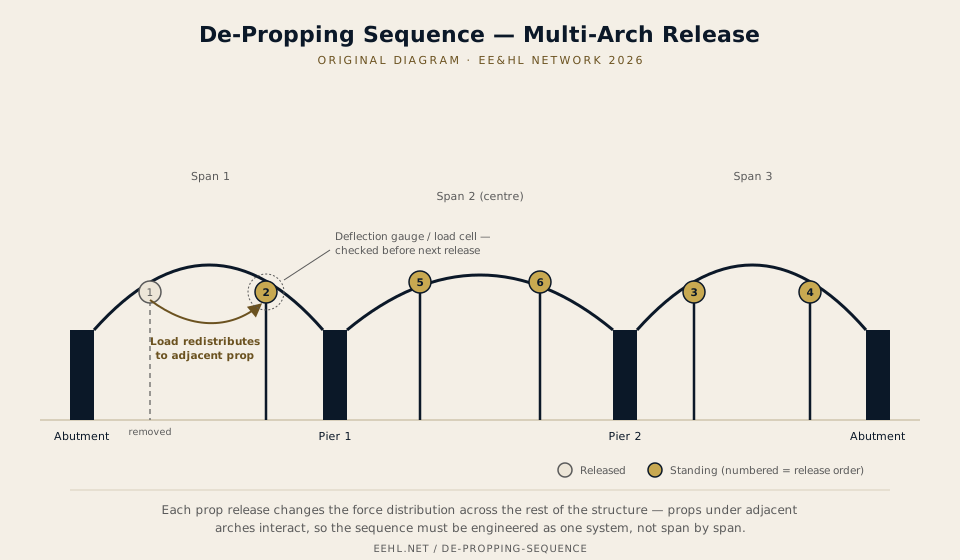
The risk compounds on structures where spans or arches interact — a de-propping sequence for one arch of a multi-arch bridge can't be designed in isolation, because the props under adjacent arches are often carrying load that depends on each other's state. A three-arch structure de-propped as three independent operations, rather than one interconnected sequence, is a structure being de-propped against an assumption the design never made.
Tap to enlarge
De-propping sequence — multi-arch release order and load redistribution
Diagram: Original — EE&HL Network 2026
Monitoring During De-Propping
Because the structure is in a temporary, partially-verified condition throughout, de-propping is normally executed with active monitoring — deflection gauges, load cells on the remaining props, and defined hold/stop criteria — so any unexpected load redistribution is caught before the next prop is released, not after.
The Commercial Dimension
De-propping typically happens at the tail end of a project, when site presence, engineering attention, and monitoring resource are all winding down toward handover. That timing is exactly what makes it dangerous: it's the phase most likely to be executed by a reduced team, under schedule pressure to reach practical completion, on a structure that is — by definition — not yet carrying load the way it was designed to. Treating de-propping as a checklist item rather than an engineered, monitored operation is a pattern that shows up disproportionately often in structural failure investigations, precisely because it sits at the seam between "still under construction" and "finished," where responsibility and attention both tend to thin out.
Frequently Asked Questions
What is de-propping in construction?
The planned removal of temporary supports — props, falsework, or shoring — once a structure becomes self-supporting, transferring load into the permanent structure in a controlled, engineered order.
Why is de-propping sequence important for arch or multi-span structures?
Props under one arch or span can interact with the load path of adjacent ones. Releasing supports out of the engineered order can redistribute load into elements never analysed for that intermediate condition.
What happens if props are removed in the wrong order?
The internal force distribution across the rest of the structure changes. Out-of-sequence removal can overload adjacent elements, and because the structure is still in a temporary, unverified state, consequences can develop with little warning.
Who is responsible for the de-propping sequence design?
The temporary works or permanent works engineer typically defines the sequence and monitoring criteria; executing it correctly on site — verifying each stage before the next release — usually sits with the contractor's site team.